
Devotions
Carmelite Charism
Who or What is a Carmelite?
Carmelite Prayer
Our Models - The Saints
Our History
Devotions
The Brown Scapular
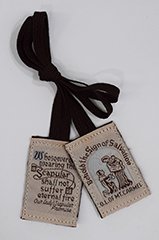
Did you know that two of the Army soldiers who were killed at Custer’s Last Stand were wearing brown scapulars? And that at least one soldier killed at Iwo Jima had one on? Perhaps you received one and were enrolled in the Confraternity of the Brown Scapular when you were confirmed.
Probably the best known Carmelite devotion is the Brown Scapular. This sacramental (little sacrament) is the part of the Carmelite religious habit worn over the shoulders (scapulae in Latin). Originally it was a type of apron and many other religious orders have the same thing. However, in 1250 a.d., Our Lady appeared to Saint Simon Stock and imparted to the scapular a spiritual meaning. It would indicate that the wearer was clothed with the protection of Mary. Not a magic charm, there were obligations on the part of the wearer. In return, Our Lady promised to speed through purgatory those faithful to this devotion.
Carmelite nuns and friars for the most part wear a full-length scapular. Members of the Secular Order of Carmel use a smaller size. The very small ones are the most common, used by thousands of lay people. Even Saint Pope John Paul II wore one. We have them for sale in our gift store here.
“The lives of the Carmelite saints are proof that the contemplative and active life can be successfully combined and lead to sanctity.”
The Infant Jesus
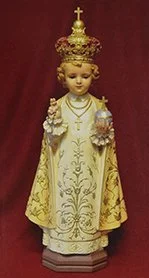
On this occasion the Princess uttered these prophetical words: “I am giving you my most precious earthly possession. Honor and respect the Child Jesus, and you will never know want.” This statue upon being venerated became the source of numerous miraculous favors.
In 1631 the Saxons seized Prague. The Carmelites fled from the monastery. The monastery was plundered and the Infant Jesus damaged and discarded as junk. The monks returned to Prague in 1637. With them was Father Cyril of the Mother of God who remembered his time as a novice and the powerful intercession of the Infant Jesus. He found the statue among old junk. With great sorrow he discovered that both its arms had been broken off. During prayer he heard the Infant Jesus say: “Have mercy on me and I will have mercy on you. Give me my arms and I will give you my peace. I will bless you as much as you will venerate me!” Eventually, Father Cyril was able to have new arms made for the Infant Jesus. The Infant Jesus began to bless the monastery, the local people, and also the entire city of Prague. He was credited with miraculous healings and with saving Prague during the Swedish siege in 1639.
So many graces, blessings, and miraculous cures came to those who took up this devotion, that it began to spread to other countries, until in our day, it is known throughout the Catholic world. We have a booklet for sale - Novena to the Miraculous Infant Jesus of Prague here.
Almost every Catholic has seen a statue of the Infant Jesus of Prague. A little King, dressed up in real clothes, holds the world in one hand and blesses with the other. Sometimes the clothing is even changed to match the liturgical color of the season! But far from a playing-with-dolls type of devotion, the Infant Jesus is meant to teach us about the irony of His all-powerful Kingship which is invested in a new-born child born in a stable, and to encourage us to become like little children in order to enter His Kingdom.
What is less known is the Carmelite origins of devotion to the Infant Jesus. Devotion to the Infant of Prague began in the monastery of Discalced Carmelite Fathers of Prague. The Kingdom of Bohemia and the Kingdom of Spain had close ties. María Maximiliana Manriquez de Lara y Mendoza brought the image to Bohemia upon her marriage to Czech nobleman Vratislav of Pernstyn. An old legend in the Lobkowicz family reports that María's mother, Doña Isabella, had been given the statue by Saint Teresa of Ávila herself. María received the family heirloom as a wedding present. It later became the property of her daughter, Polyxena, 1st Princess Lobkowicz. She donated the statue to the Discalced Carmelite Friars in Prague.
The Holy Face
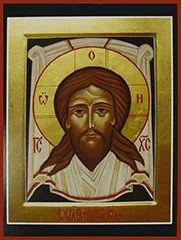
Somewhat less known now than in the last century is the devotion to the Holy Face of Jesus. This was started in 1843 by Sister Marie of Saint Peter, O.C.D., who was a Discalced Carmelite nun who lived in Tours, France. She had visions of the sufferings of Our Lord. This devotion was later promoted by Venerable Leo Dupont, also known as "The Holy Man of Tours” or the "Apostle of the Holy Face". We pray "It is Your Face, O Lord, that I seek; show me Your Face," but we must find that most beautiful of all faces in one that shows the marks of torture and sorrow.
A more modern take on this devotion might be the contemplation of the Holy Shroud of Turin. The photographic image taken from it rivets the viewer. Jesus was indeed the Man of Sorrows, but His Face cannot mask His great love for us. Saint Therese of the Child Jesus and the Holy Face had a great love for this devotion.
We have this holy card of the Holy Face icon for sale in our gift shop here.