
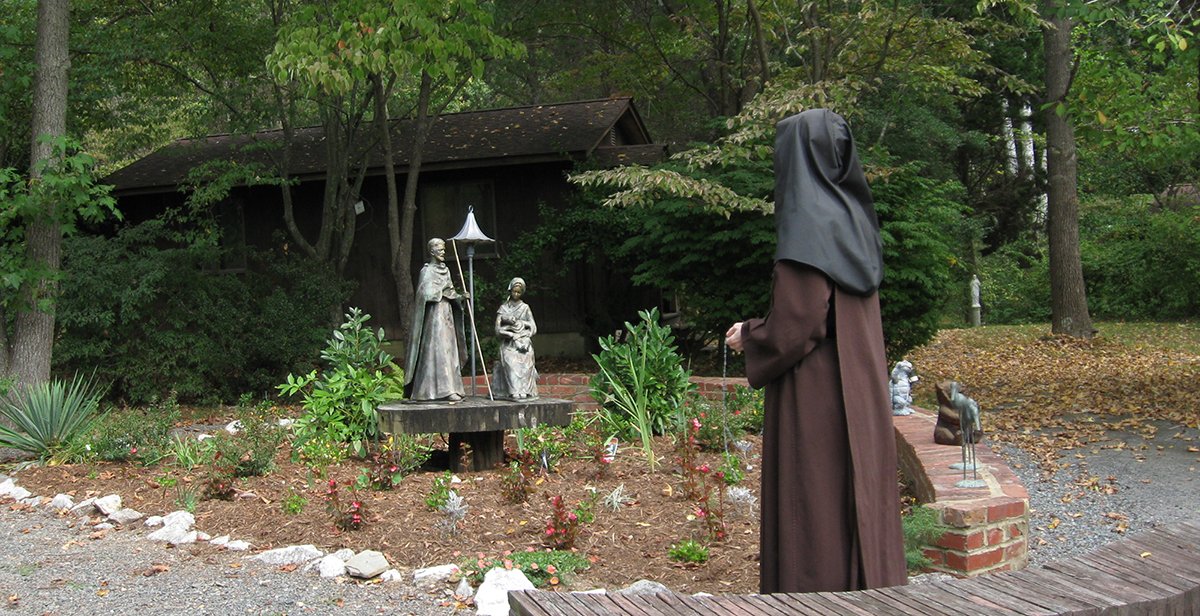
Our History
1831 – The Empty Land
1933 – Sprouts from the Stump
1976 – Home for the Harvest
1790 – The Bethlehem of Religious Life
In 1790 the American Revolution was over by less than fifteen years. Travel was still by horseback or boat. The country was just about to get its fledgling feet on the ground.
Religious freedom had been denied Catholics until shortly after the Declaration of Independence, when the laws disenfranchising Catholics were overturned by the Bill of Rights in 1787, which guaranteed Freedom of Religion. Up until this time, any American woman who wished to embrace religious life had to travel to Europe and enter a convent in Belgium or France (England, too, had anti-Catholic laws)
Display in the original Old Monastery
The well-tried faith of Southern Maryland Catholics inspired numerous young men and women to make the hazardous voyage across the Atlantic to pursue a religious vocation. In 1754, a young lady, Ann Matthews – a descendant of one of the first families in Maryland – left her home, Mt. Air in Charles County, to answer the call to the Carmelite cloister in Hoogstraeten, now in Belgium, taking the religious name Sister Bernardina Teresa Xavier of St. Joseph. As soon as the American Revolution ended, two of her nieces, Ann Teresa and Susanna Matthews, sailed across the ocean to join her in the Carmel. Sister Bernardina eventually became the prioress of the Hoogstraeten Carmel in Belgium.
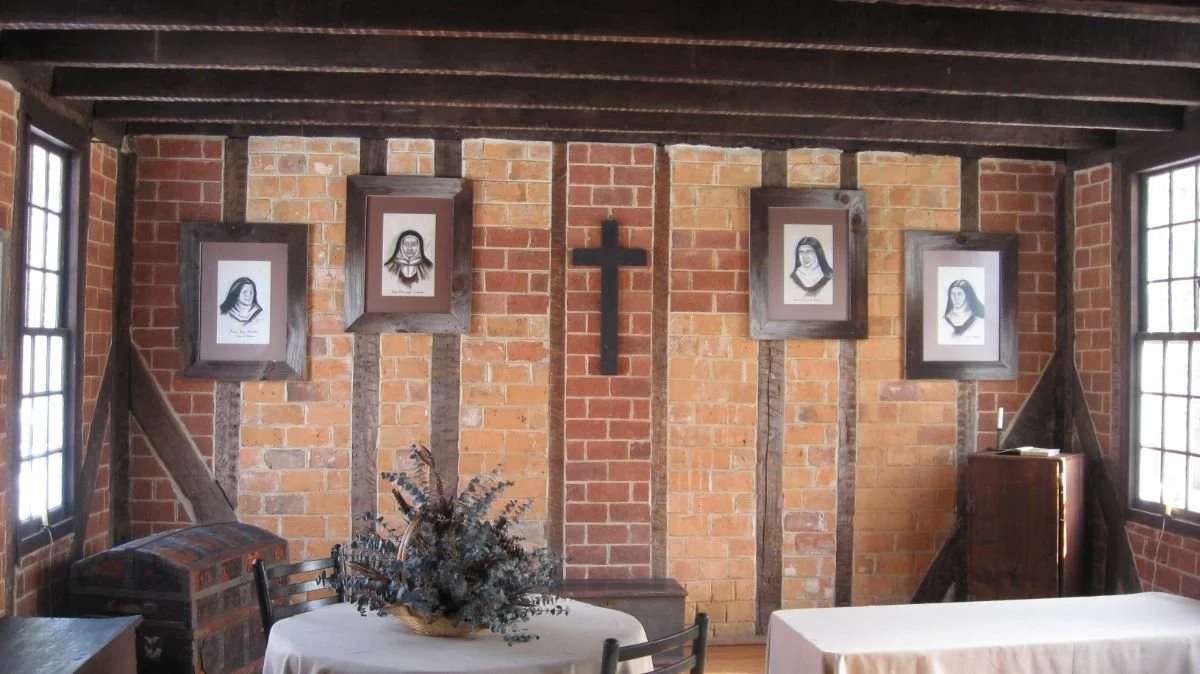
Portraits of Foundresses in 1790 Old Monastery
After the new American government was established, Mother Bernardina’s brother, Fr. Ignatius Matthews, wrote his sister, “Now is your time to found in this country for peace is declared and religion is free.” After much deliberation and planning, Mother Bernardina Matthews, her two nieces, Sister Mary Aloysia and Sister Mary Eleanora, and Sister Clare Joseph (from the Antwerp Carmel), were chosen as the four pillars upon which the English Carmelite foundation was established. The four traveled to Maryland and established Mount Carmel in the Port Tobacco valley.
Sailing from Antwerp, May 1st, 1790, they reached New York July 2nd, 1790, accompanied by Fr. Charles Neale, S.J. their spiritual director. From New York, they made their way to Port Tobacco. Mother Bernardina continued as prioress of the new Carmel, until her death in 1800, when she was succeeded by her sub-prioress, Mother Clare Joseph Dickenson.
Upon Mother Bernardina’s death, there were fourteen sisters in the community in Maryland. Seven years later, Mother Clare Joseph reported that the number had increased to twenty. Due to her important role in the early foundations of the Port Tobacco Carmel, Mother Clare Joseph was given the title of Co-Foundress of the monastery.
With the death of their beloved chaplain, Fr. Neale, in 1823, the deterioration of the monastery buildings, the failure of the agriculture (which sustained the nuns), and the toll of law suits made it imperative that the nuns move to a more populated area.
“It is sweet to think of Jesus; but it is sweeter to do His will.”
1831 – The Empty Land
In 1831 Archbishop James Whitfield of Baltimore decided to bring the Nuns to Baltimore. There they could support themselves with a school and more readily receive the charitable contributions of a growing Catholic population. Mother Angela (Mary Anne Mudd), the last Prioress at Port Tobacco, had the sad responsibility of moving the Nuns to Baltimore.
The monastery’s original location in Port Tobacco was sold to a farmer, but it remained dear to every American Carmelite throughout the next century. The number of Nuns grew in Baltimore, but in the meantime those in the Port Tobacco area never forgot them.
Aided by the Sisters of Charity, they opened a Carmelite school for girls in the 200 block of Aisquith Street. Bishop Carroll had obtained permission from the Pope to allow the Sisters to teach. They remained at the Aisquith Street building for 40 years, when in 1873 they moved to their Carmel on Caroline and Biddle Streets. From it seven other Carmels were founded, and from these at least 35 more, all in the United States. In 1961, they moved to their present location in the Dulaney Valley, Baltimore, Maryland.
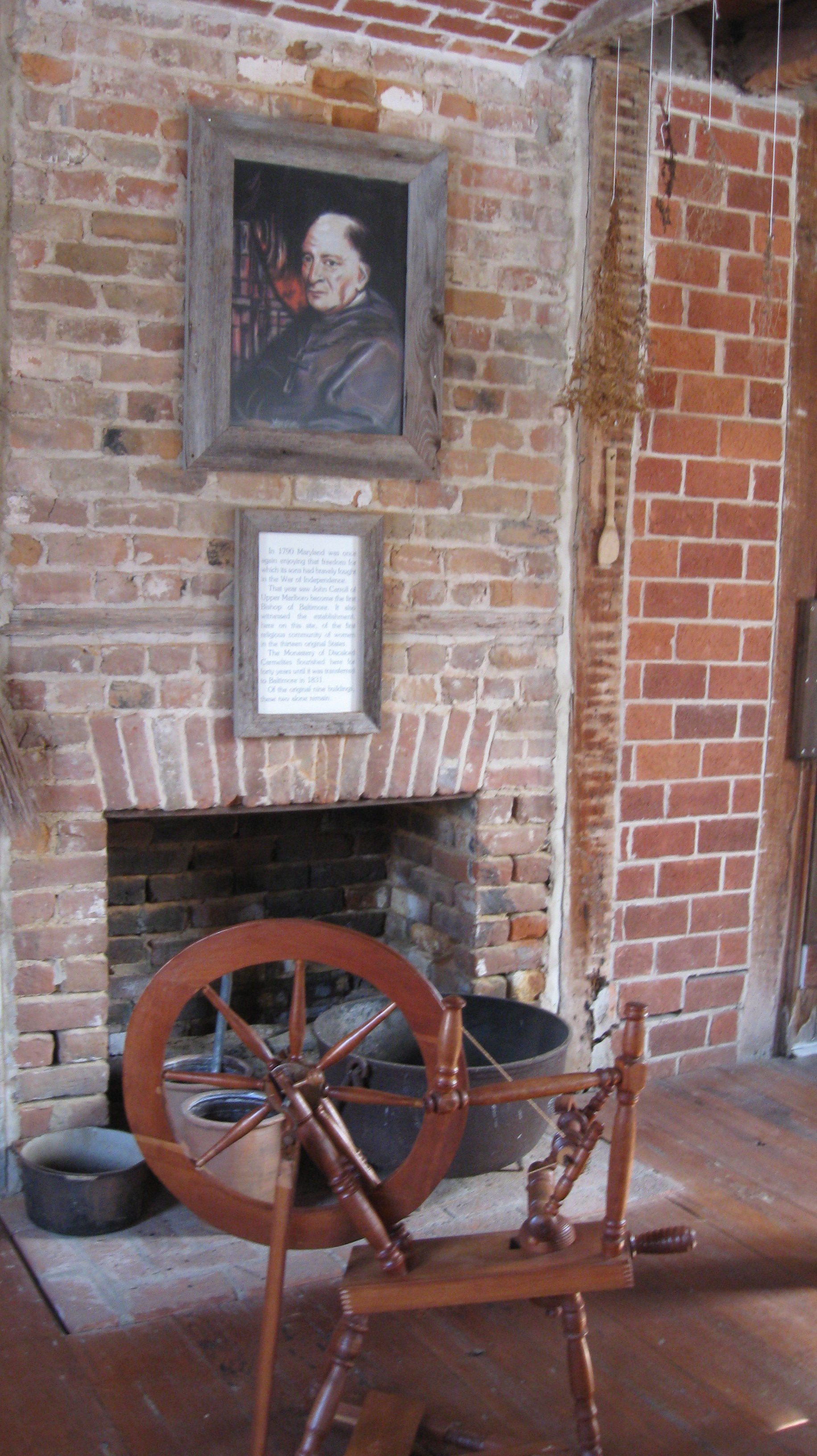
Archbishop John Carroll
After 100 years, the original Mount Carmel Monastery had almost disappeared. In 1890, Bishop Charles W. Currier published Carmel in America in which he made a sketch from authentic descriptions of the monastery buildings as they were in 1831. In that group can be seen the two surviving buildings, which were moved together in about 1910.
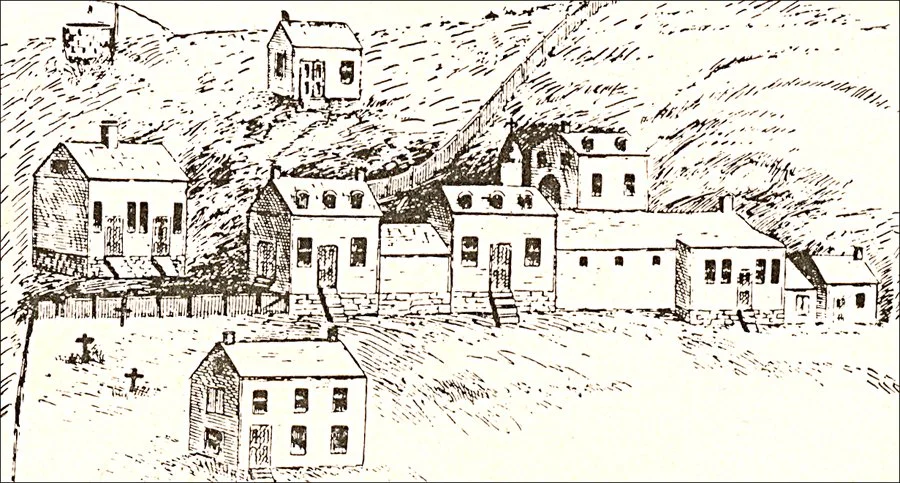
Sketch of original buildings
1933 – Sprouts from the Stump
Efforts of the late Mrs. Benjamin E. Talbott of Washington (born Mary Cecelia Hamilton) and her daughter, the late Mrs. John Hagerty, sparked the restoration campaign, which began in 1935. The Most Reverend Archbishop Curley heartily approved the project and named the Society “The Restorers of Mount Carmel in Maryland”. This organization’s express purpose was to save the only two remaining old buildings, create a Catholic shrine, and, hopefully, work for the reestablishment of the Nuns here at their original site.
By means of pilgrimages and fund-raising efforts, they completed the restoration and erected a chapel and a meeting hall over the foundations of the monastery where the Nuns had lived and prayed.
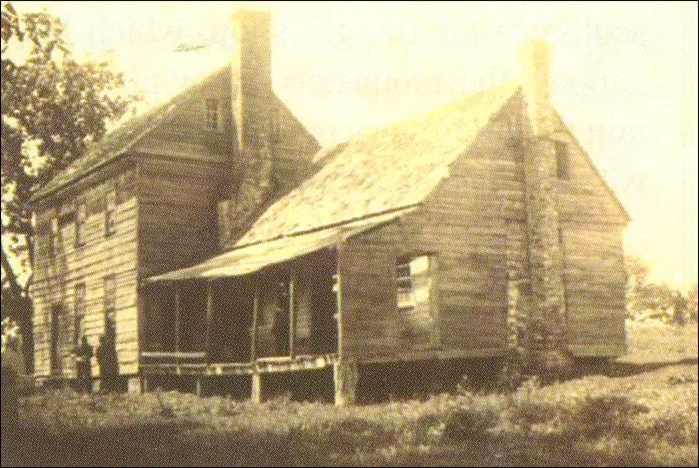
Old Monastery - 1936
A Pilgrim’s Chapel
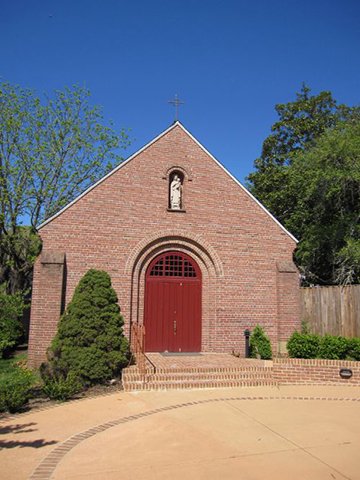
A new rose brick colonial Chapel of Our Lady was completed and dedicated during the Marian Year on November 14, 1954 by Most Reverend Patrick A. O’Boyle, Archbishop of Washington.
Public pilgrimages are made during the year. The Holy See grants a plenary indulgence to all who make a public pilgrimage, and five years indulgence for a private pilgrimage. (See more on our Place of Pilgrimage page.)
1976 – Home for the Harvest
The little miracle of re-foundation came about in 1976, when six brave Carmelite Nuns returned. They built hermitages to live in and divided the meeting hall into community rooms. The start-up was more difficult than anticipated and by 1982 their number had decreased to three. It was then that James Cardinal Hickey, Archbishop of Washington, invited the Association of Saint Teresa to come and fortify the ranks of the fledgling Carmel. Since that time the Carmelites Nuns at Port Tobacco has steadily increased.
On the summit of Mount Carmel, Maryland, overlooking Port Tobacco Valley, there stands today, the restored buildings of the first convent of religious women established in the original Thirteen States.
A more complete history is available in Who Remember Long, which can be purchased from our gift shop here.